

Direct Neoantigen Validation & Quantification Platform Since 2014
Valid-NEO® is engineered to bring certainty to neoantigen-targeted immunotherapy development through direct detection, quantification, and validation of HLA-presented neoantigens from clinical samples — without prediction and without guesswork.
In cancer immunotherapy, presentation of a mutant peptide on the cell surface is the fundamental signal that enables TCR recognition, vaccine efficacy, and targeted drug engagement. Computational prediction methods can suggest binding affinity, but strong binder does not equal presentation. Valid-NEO® directly captures and identifies actual neoantigens displayed on patient samples, giving you experimentally confirmed, quantitatively measured targets before you commit to therapeutic engineering.
PREDICTION-FREE Clinical Evidence, Not Inference
Valid-NEO® is built on an integrated multi-omics immunopeptidomics pipeline capable of isolating essentially all MHC (HLA) molecules and the peptides they present, enabling direct observation of tumor neoantigens and absolute quantification from limited clinical samples, including biopsies. Our pipeline doesn’t rely on computational binding predictions: we directly see what’s presented — no guessing.
The Difference Between Hypothesis and Proof
Computational affinity does not guarantee presentation. Valid-NEO® isolates HLA complexes, identifies neoantigen sequences, and measures abundance directly from clinical samples.

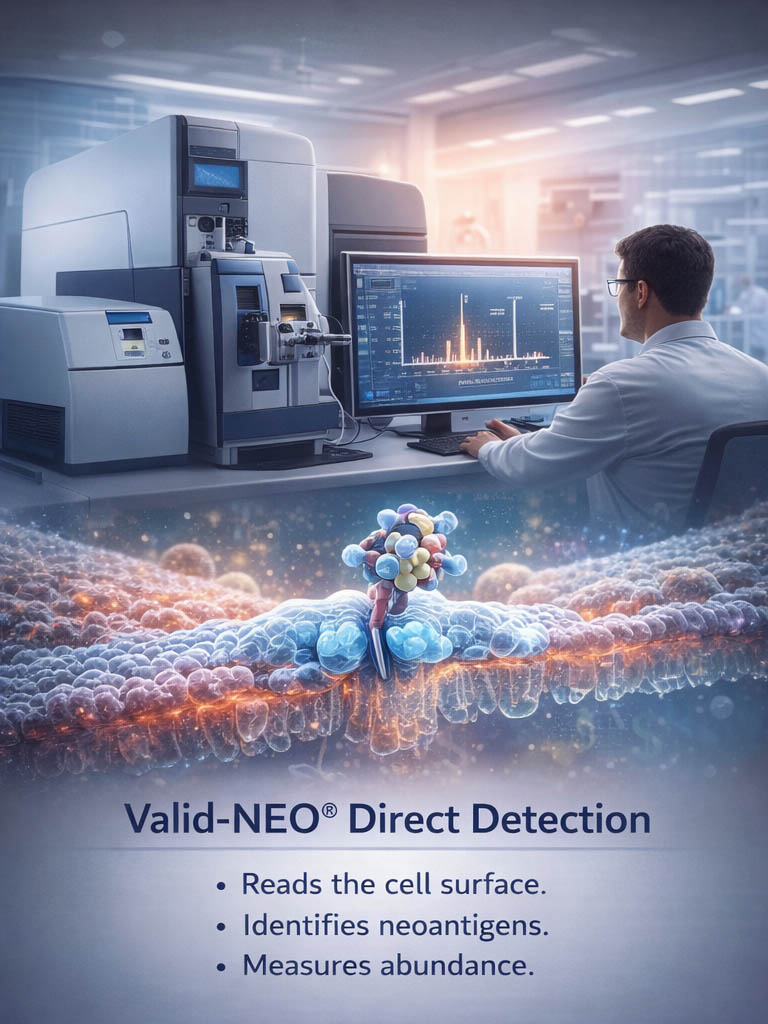
In immunotherapy, only measured presentation creates actionable targets.
Translational Impact, Built on Proven Science
Neoantigen therapeutics rise or fall on one non-negotiable principle: the target must be genuinely presented on the tumor cell surface — and at biologically meaningful abundance. Valid-NEO® eliminates uncertainty at this critical checkpoint by directly measuring HLA-presented neoantigens and quantifying their levels before capital is deployed into engineering, manufacturing, and clinical development. Built on over a decade of innovation and peer-reviewed validation, the platform has enabled category-defining breakthroughs in immuno-oncology, including the first direct identification and quantitative measurement of neoantigens derived from the two most frequently mutated cancer driver genes, TP53 and KRAS — targets long considered essential yet technically inaccessible due to their extremely low tumor cell surface abundance. By demonstrating that these high-value oncogenic mutations are not only presented but quantifiable, Valid-NEO® fundamentally expanded what is actionable in cancer immunotherapy. Today, Valid-NEO® supports multiple pharmaceutical development programs targeting these validated epitopes, positioning Complete Omics Inc. at the functional control point between genomic discovery and therapeutic execution. The selected publications below document the scientific rigor and translational impact of Valid-NEO® that substantiate this thesis:
- Science. 2021 Mar 5;371(6533):eabc8697. Targeting a neoantigen derived from a common TP53 mutation.
- Science Immunology . 2021 Mar 1;6(57):eabd5515. Bispecific antibodies targeting mutant RAS neoantigens.
- Science Advances. 2022 Jan 28;8(4):eabj3671. Identification of shared tumor epitopes from endogenous retroviruses inducing high-avidity cytotoxic T cells for cancer immunotherapy.
- Cancer Immunol Res . 2019 Nov;7(11):1748-1754. Direct Detection and Quantification of Neoantigens.
- Journal for Immunotherapy of Cancer. 2025 Aug 3;13(8):e010099. HERV-derived epitopes represent new targets for T-cell-based immunotherapies in ovarian cancer.
- Cancers . 2022 Feb 28;14(5):1243. Valid-NEO: A Multi-Omics Platform for Neoantigen Detection and Quantification from Limited Clinical Samples.
- Blood Advances. 2022 Dec 9;7(9):1635–1649. Shared graft-versus-leukemia minor histocompatibility antigens in DISCOVeRY-BMT.
- Cell Press Sneak Peek . 2020 Oct 19 http://dx.doi.org/10.2139/ssrn.3704016. MINERVA: Learning the Rules of HLA Class I Peptide Presentation in Tumors with Convolutional Neural Networks and Transfer Learning.