

Standardizing Proteomics for Reproducibility, Quantitative Discipline, and Clinical Feasibility
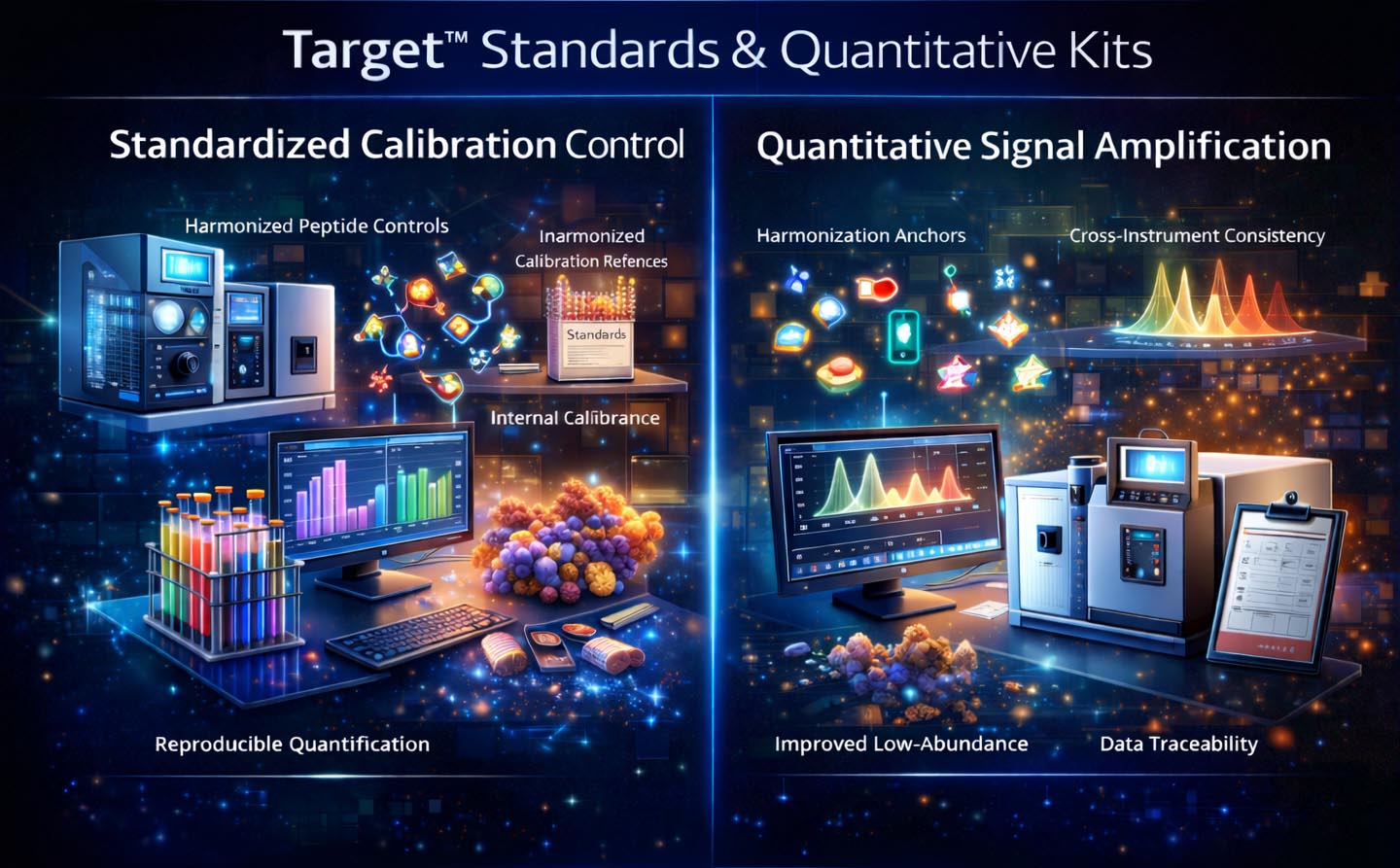
Target™ Standards & Quantitative Kits are engineered to strengthen reproducibility, calibration control, and quantitative stability in everyday proteomics workflows. Developed through collaborative efforts integrating translational proteomics expertise and harmonized measurement principles, these kits provide structured performance anchors that elevate routine LC–MS/MS assays toward greater consistency and clinical feasibility.
Proteomics has achieved remarkable depth, yet variability across runs, instruments, and laboratories continues to limit translational confidence. Target™ Standards introduce defined internal calibration peptides, quantitative reference panels, and structured quality control checkpoints directly into standard workflows. Rather than altering existing acquisition strategies, the system enhances them — improving identification confidence, stabilizing abundance measurements, and reducing cross-batch variability.
This is not a new instrument platform. It is a measurement discipline layer.
Advancing Reproducibility Toward Clinical Alignment
Clinical translation demands stability over time and across environments. Target™ Standards embed quantitative anchors within each run, enabling laboratories to monitor signal consistency, control dynamic range performance, and detect instrument drift before it impacts data integrity.
By integrating calibration references and harmonization checkpoints into routine assays, datasets become more transportable across cohorts and more defensible in translational studies. Longitudinal monitoring improves. Multi-site collaborations gain comparability. Biomarker discovery workflows become structurally stronger.
Reproducibility is not left to statistical correction after data generation — it is embedded into the measurement event itself.
Technical Performance Framework
The core performance structure of Target™ Standards & Quantitative Kits includes:
| Specification Category | Performance Objective | Practical Impact |
|---|---|---|
| Intra-run CV Target | ≤10–15% for calibrated peptides | Stable quantification within runs |
| Inter-batch CV Target | ≤15–20% across batches | Improved longitudinal comparability |
| Dynamic Range Anchoring | Structured calibration across 4–5+ orders of magnitude | Enhanced low-abundance signal reliability |
| Retention Time Controls | Indexed internal RT standards | Consistent peak alignment |
| QC Checkpoints per Run | Multi-level internal peptide controls | Early detection of variability |
| Cross-Instrument Harmonization | Reference normalization panel | Multi-site comparability support |
| Traceability Documentation | Lot-specific calibration tracking | Facilitates translational documentation |
These specifications are designed to support biomarker validation, longitudinal cohort studies, and translational research environments where reproducibility is critical.
Seamless Integration, Elevated Standards
Target™ Standards & Quantitative Kits integrate directly into existing DDA, DIA, and targeted workflows without requiring instrument modification or disruption of established laboratory processes. They are designed to enhance — not replace — current platforms by strengthening quantitative rigor, calibration control, and structural stability within everyday assays. By embedding harmonized measurement anchors into routine workflows, laboratories can support discovery proteomics, targeted validation panels, translational biomarker development, and early-stage clinical feasibility studies with greater reproducibility and confidence.
As proteomics advances toward regulated applications and clinical implementation, reproducibility and calibration discipline must become foundational rather than exceptional. Target™ Standards raise the operational baseline of proteomics, helping transform routine measurement into structured, transportable molecular evidence.
Depth drives discovery. Reproducibility enables application. Target™ Standards are built to strengthen both.