
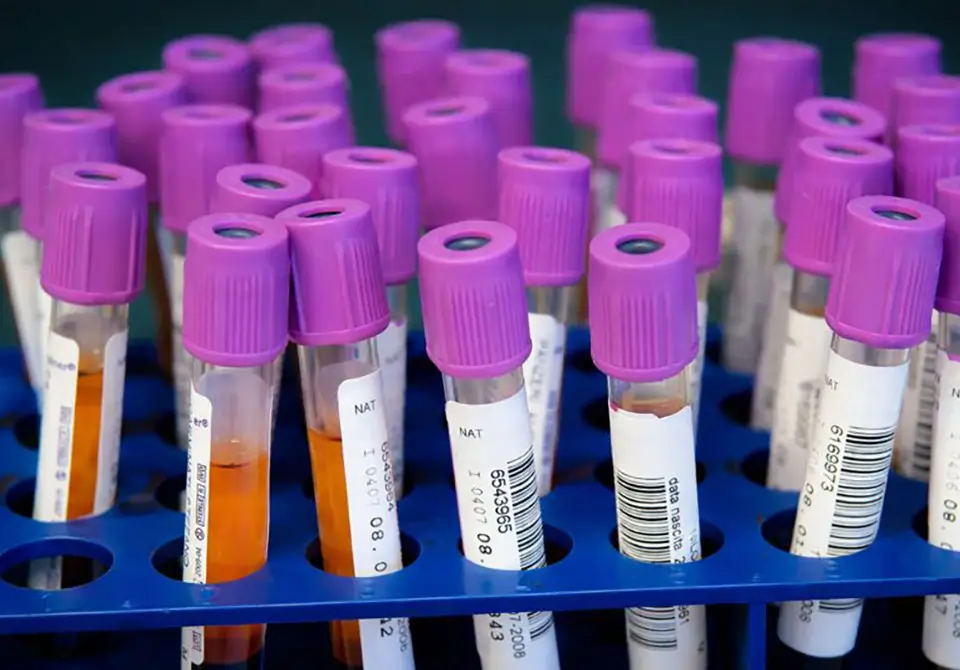
Complete360® — Mass Spec with CONFIDENCE.
The Functional Molecular Infrastructure Layer of Precision Medicine
Genomics mapped risk. Proteomics defines real-time biological state. Complete360® is engineered to become the functional molecular infrastructure layer that modern healthcare depends on. Operating seamlessly across plasma, tissue, and longitudinal clinical cohorts, the platform delivers ultra-deep, harmonized, clinically reproducible proteomic intelligence at scale. This is not merely a service offering. It is the execution layer for the next era of diagnostics, therapeutics, and AI-assisted clinical decision systems.
The Structural Shift to Functional Biology
Healthcare is undergoing a structural transition. Genomics established the molecular blueprint, but blueprints do not drive clinical decisions — biological function does. Early detection, continuous monitoring, mechanism-driven therapy selection, and AI-enabled interpretation all require real-time measurement of protein activity, immune architecture, and disease-state dynamics. Proteomics is the modality that captures biological execution. Complete360® transforms proteomics from fragmented research into scalable clinical infrastructure capable of powering that transition.

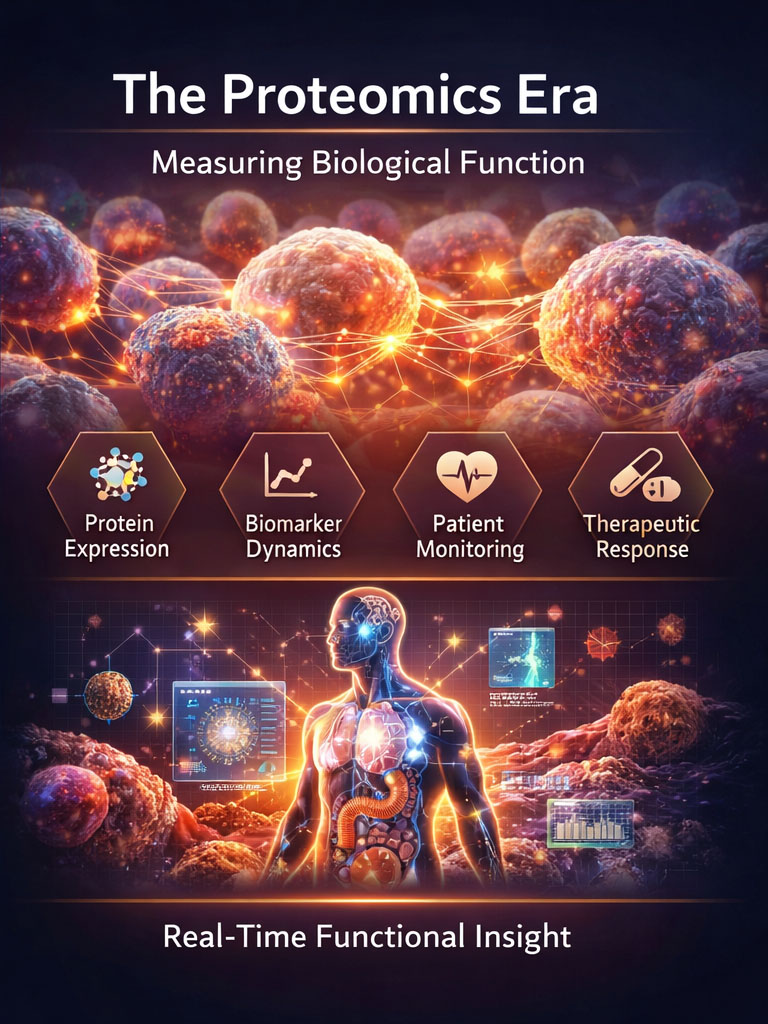
From Experimental Measurement to Scalable Infrastructure
For decades, proteomics remained powerful yet inconsistent, confined to academic depth without clinical reproducibility. Complete360® resolves this fragmentation by integrating standardized wet-lab workflows, proprietary acquisition architecture, internal calibration systems, and AI-driven cross-cohort harmonization into a unified execution framework. The platform quantifies more than 10,000 proteins per sample while preserving sensitivity for low-abundance, disease-defining signals and post-translational modifications. Circulating biomarkers are validated directly in matched tissue under the same architectural discipline, enabling systemic–tissue convergence rather than disconnected datasets. What was once experimental output becomes reproducible molecular infrastructure.
A Compounding, Defensible Platform
Complete360® has been engineered under real clinical pressure and validated across oncology, immunotherapy, and large-scale translational cohorts where sensitivity, reproducibility, and regulatory alignment are non-negotiable. What began with early demonstrations of direct mutant protein detection has evolved into an AI-calibrated, high-throughput proteomic architecture designed for harmonized cross-cohort execution and real-world clinical deployment. Each additional study compounds the platform — generating immediate translational revenue while expanding a durable, harmonized molecular intelligence asset that strengthens defensibility over time. Supported by a growing global portfolio of more than 40 filed and granted patents spanning acquisition architecture, quantitative calibration systems, harmonization methodologies, and clinical deployment workflows, Complete360® protects not just measurement techniques but the integrated system required for scalable clinical proteomics. As proteomics becomes foundational to precision medicine, control of the functional measurement layer becomes strategically decisive. In every technological transition, enterprise value concentrates at the infrastructure layer, and Complete360® is engineered — and protected — to own that layer in the proteomics era.
► The Foundational Work That Made Complete360® Inevitable
- Proc Natl Acad Sci U S A. 2011 Feb 8;108(6):2444-9. Mutant proteins as cancer-specific biomarkers.
- Proc Natl Acad Sci U S A. 2017 Dec 19;114(51):13519-13524. Selected reaction monitoring approach for validating peptide biomarkers.
► Selected Publications Enabled by Complete360®
- Cell. 2025 Aug 7;188(16):4225-4238.e12. doi: 10.1016/j.cell.2025.05.038. Wang X, et al. An iPSC-derived CD19/BCMA CAR-NK therapy in a patient with systemic sclerosis.
- Nature Communications. 2025 Jan 30;16(1):1191. doi: 10.1038/s41467-025-56492-8. Jia Y, et al. Mitochondrial KMT9 methylates DLAT to control pyruvate dehydrogenase activity and prostate cancer growth.