
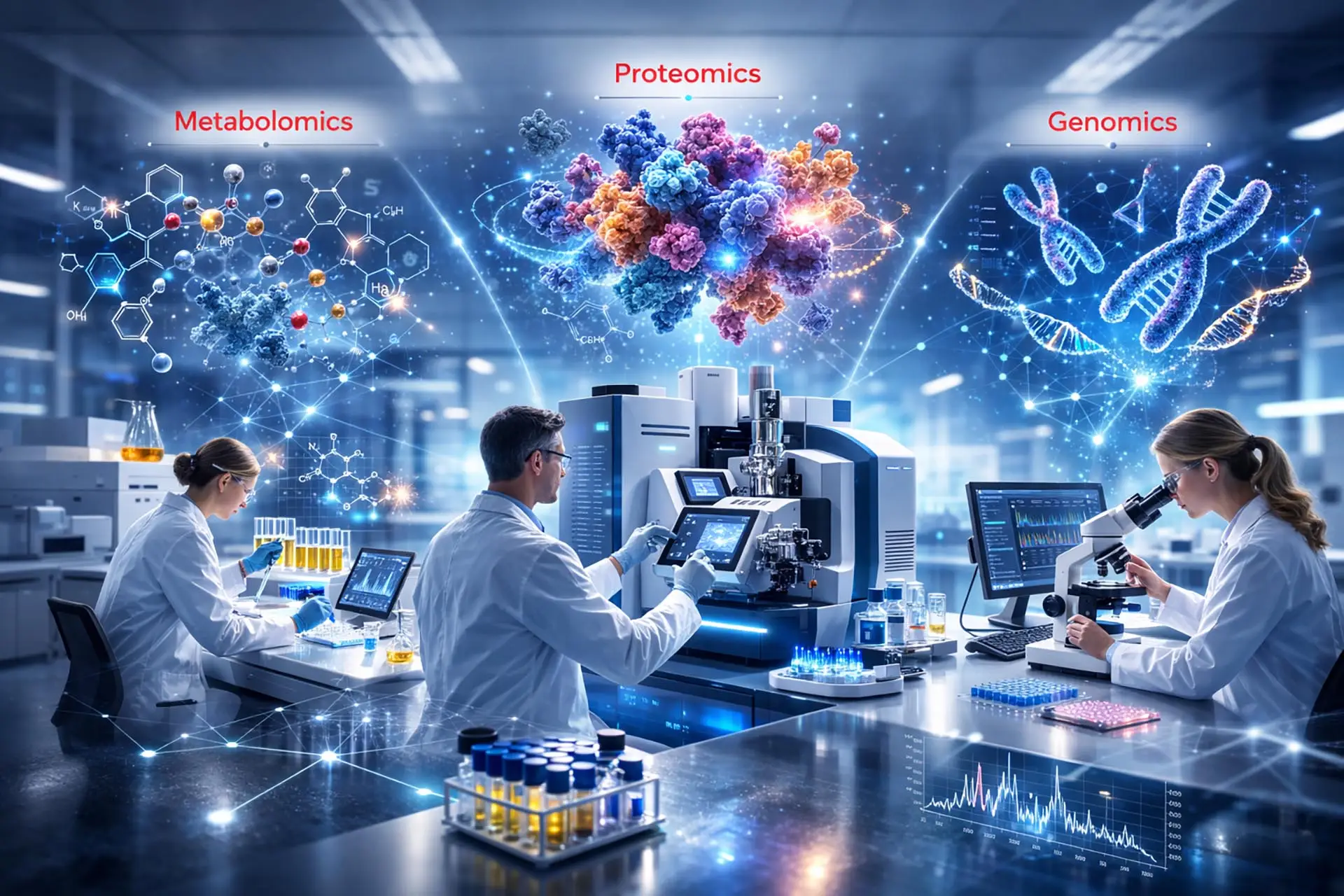
Comprehensive Discovery and Quantification Workflows
We provide full-spectrum classical proteomics and metabolomics services covering discovery, targeted quantification, and pathway-level analysis across diverse biological sample types. Our workflows are compatible with plasma, serum, CSF, urine, fresh tissue, FFPE, cell lines, PBMCs, and engineered models, and are designed to support exploratory research, hypothesis testing, and biomarker discovery programs.
Traditional proteomics and metabolomics service providers typically offer differential expression analysis, label-free quantification, TMT-based multiplexing, DIA and DDA workflows, targeted MRM/PRM panels, pathway enrichment analysis, metabolite identification, and statistical interpretation. These services are essential for generating biological insight and remain foundational to modern molecular research.
We provide all of these capabilities — executed with high technical rigor and scalable laboratory infrastructure.
What Traditional Services We Deliver
Complete Omics’ classical proteomics and metabolomics services include:
- Global protein identification and label-free quantification
- TMT-based multiplexed comparative proteomics
- Data-dependent (DDA) and data-independent (DIA) acquisition workflows
- Targeted MRM/PRM quantitative panels
- Post-translational modification (PTM) analysis
- Metabolite profiling and pathway analysis
- Differential expression and bioinformatics reporting
- Basic quality control metrics and run-level validation
These workflows generate valuable datasets for discovery research, exploratory biomarker identification, and mechanistic pathway studies.
Our Structural Advantages
While traditional services focus primarily on data generation, our approach emphasizes depth, reproducibility, and translational feasibility from the outset.
First, we integrate harmonized calibration frameworks and structured quality controls that enhance cross-batch and cross-cohort stability. Rather than relying solely on post hoc normalization, measurement discipline is embedded within acquisition and processing.
Second, we emphasize quantitative robustness across dynamic ranges, enabling improved detection of low-abundance biomarkers and more reliable longitudinal comparison.
Third, our workflows are designed with downstream clinical feasibility in mind. Data architecture, documentation standards, and reproducibility targets are aligned to support biomarker validation, translational studies, and early regulatory engagement rather than purely exploratory analysis.
Fourth, when required, classical workflows can be integrated seamlessly with advanced platforms such as immunopeptidomics or calibrated quantitative standards, allowing programs to evolve without switching providers or rebuilding analytical frameworks.
Why Choose Us
Many service providers can generate proteomics or metabolomics datasets. Fewer can structure those datasets to remain stable, comparable, and defensible under translational pressure.
We combine comprehensive classical workflows with harmonized measurement principles, quantitative calibration discipline, and cross-cohort comparability strategies. This enables clients not only to discover signals, but to evaluate whether those signals can withstand replication, scale, and eventual clinical application.
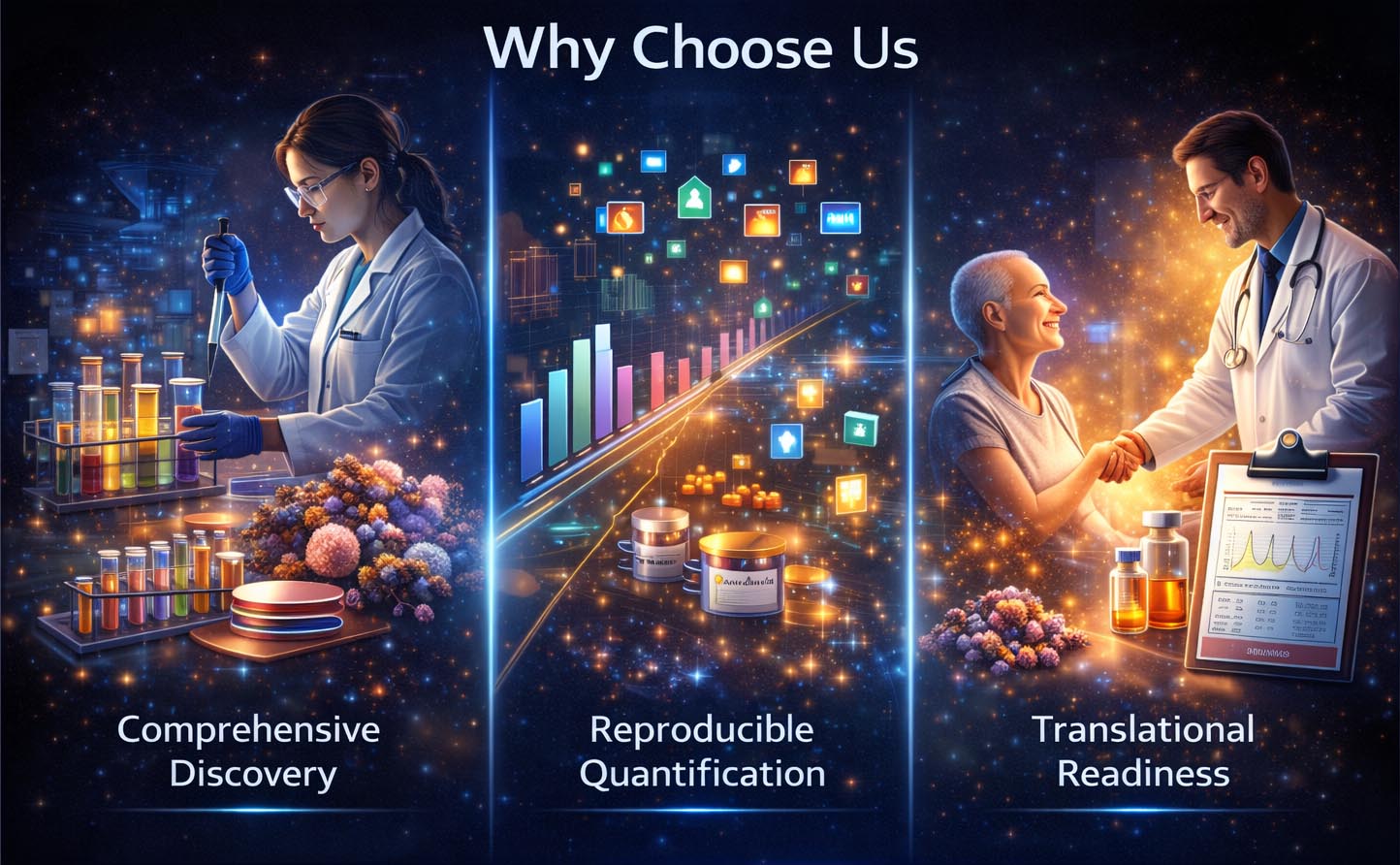
Discovery is the starting point. Reproducibility determines durability. Translational readiness determines value. Our goal is to support all three.